

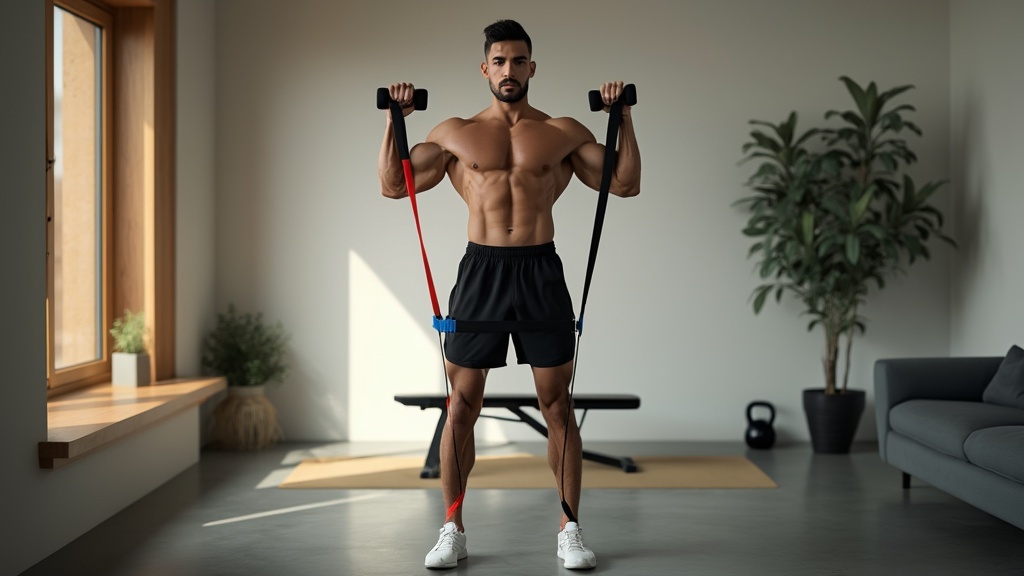
This $15 Tool Beats Your $2000 Home Gym (Science Proves It)
Your gym membership expired. Your dumbbells are gathering dust. But here's something that'll make you rethink everything about home strength training: that $15 set of resistance bands might be the most underestimated muscle-building tool in your closet.
I know, I know. Bands feel like fitness toys compared to cold iron. But here's the thing—while you've been scrolling through expensive home gym setups on Reddit (yep, resistance band workouts are exploding in popularity for 2025), sports scientists have been quietly proving something fascinating: your muscles can't tell the difference between a 50-pound dumbbell and 50 pounds of elastic tension.
And that changes everything.
How Resistance Bands Stimulate Muscles (Spoiler: It's Not What You Think)
Here's where most people get bands completely wrong. They think it's about convenience. Or portability. But the real secret? Variable resistance.
Unlike free weights that stay the same weight throughout your entire rep, bands get stronger as you stretch them. This means they actually match your muscle's natural strength curve better than traditional weights. Your bicep is strongest in the middle of a curl, weakest at the bottom—and bands provide exactly that progression.
A 2018 study in the Journal of Applied Biomechanics found that elastic bands produce comparable muscle activation levels to dumbbells when resistance is properly matched. Translation? Your muscles are working just as hard, they just feel different doing it.
But here's the kicker most people miss…
Comparing Bands to Free Weights: The Strength & Hypertrophy Reality Check
Time for some uncomfortable truth: if you're expecting bands to feel exactly like weights, you're setting yourself up for disappointment. They don't. And that's actually their superpower.
An 8-week randomized controlled trial published in the Journal of Strength and Conditioning Research put this to the test. They split untrained subjects into two groups—one using progressive resistance bands, the other using free weights. The results? Similar increases in both muscle strength and thickness.
Read that again. Similar muscle growth.
But here's what the study didn't tell you (and why most people fail with bands): it only works when you apply proper progressive overload. You can't just grab the same red band for three months and expect miracles.
The variable resistance curve also means you need to rethink your training. That "easy" bottom portion of a movement? It might feel light, but the stretched position is where bands really shine—creating maximum tension exactly where your muscles can handle it most.
Sounds simple, right? Not exactly…
Effective Programming: Progressive Overload with Bands (This Is Where Most People Fail)
Here's the mistake almost everyone makes: they treat bands like they're training with weights. Wrong game, wrong rules.
Progressive overload with bands isn't about adding more plates—it's about manipulating tension, range, and positioning. Want to make that chest press harder? Step further from your anchor point. Need more challenge? Use a thicker band. Want to target different strength curves? Adjust your starting position.
The smartest band programs use a three-tier approach:
Week 1-2: Master the movement patterns with moderate tension. Focus on controlling the eccentric (lowering) portion—bands want to snap back fast.
Week 3-4: Increase baseline tension by stepping further away or switching to thicker bands. Add pauses at peak contraction.
Week 5-6: Combine multiple bands, vary starting positions, and introduce time-under-tension protocols.
But here's what separates the people who see real results from those who quit after two weeks: tracking tension, not just reps. That means noting your distance from anchor points, which bands you're using, and how the resistance feels at different points in the movement.
Most people wing it. Most people plateau fast.
Common Mistakes and Best Practices (The Reality Check You Need)
Let's cut straight to what's sabotaging your band workouts:
Mistake #1: Treating them like cables. Bands aren't gym cables. They have personality—they store energy, they want to snap back, they change resistance throughout the movement. Fight this, and you'll hate band training. Work with these characteristics, and you'll discover why Olympic athletes use them.
Mistake #2: Ignoring the eccentric. That rubber wants to yank your arm back to starting position. Resist it. Control it. That eccentric (negative) portion is where serious muscle damage happens—the good kind that builds strength.
Mistake #3: Anchor point amnesia. Your anchor point determines everything—resistance curve, safety, effectiveness. Door frames work for some exercises, but serious band training needs dedicated anchor points at multiple heights.
Mistake #4: Band quality denial. Those $5 bands from the bargain bin? They'll snap mid-rep and possibly injure you. Quality bands with proper weight ratings aren't expensive—they're insurance.
The reality check? Bands won't replace every aspect of weight training. They're incredible for hypertrophy, decent for strength building, but limited for absolute max strength development. You're not going to deadlift 500 pounds with rubber.
But for building muscle, losing fat, and developing functional strength that translates to real-world movement? They're not just adequate—they're often superior.
TL;DR: • Bands provide variable resistance that better matches your muscle's natural strength curves • Studies show similar muscle growth compared to free weights when progressive overload is applied correctly • Success requires tracking tension and distance, not just reps and sets • Quality bands and proper anchor points are non-negotiable for safety and results • They excel at hypertrophy and functional strength, but won't replace max strength training
Ignore the equipment snobs. Your muscles don't care about the tool—they care about the challenge. And with proper programming, those "simple" resistance bands can challenge you in ways that might surprise you.
Your home gym doesn't need to cost thousands. Sometimes it just needs to be smart.
